Accounting/auditing procedures:
Appraisal, quotation, signing the agreement on accounting and tax return → organizing the documents and handling the accounts → completing the accounting and issuing the financial statements → submitting to the Hong Kong auditor for audit → completing the audit and issuing the first draft of the audit for the client's checking → issuing the final draft of the audit for the director's signature → submitting the audit report to the Hong Kong Inland Revenue Department to file the tax return → the audit report and the receipt of the tax return return return to the client.
The information required to be provided by the Hong Kong Account Settlement:
1 Bank statements and water bills; Note: The monthly statements and bank water bills on the Internet banking are generally only automatically retained for the past three months, so please download them regularly.
2 Invoices: purchase and sales invoices, service invoices (if any), purchase and sales invoices for the first 3~5 transactions in the following year and the corresponding receipts and payment documents, etc.
3 Expense invoices: salary, rent (lease contract or agreement must be provided), freight, etc.
4 Government information: company establishment documents, change documents, annual audit documents, etc. (the search center shows all the government documents of your company)
Which companies need a book audit?
In Hong Kong, a company without operation can directly file zero tax return, while a company with operation must do accounts and audit before filing tax return.
Anyone who meets one of the following criteria is considered to be in business and must do accounts and audit before filing a tax return:
1. the company has business records in the bank account
2. the company has import and export records with government customs and logistics companies
3. the company and Hong Kong merchants have a purchase and sale relationship
4. the company employs staff in Hong Kong
5. the company is permitted or authorized to use patents, trademarks, designs, etc. in Hong Kong.
6. the company is permitted or authorized to use movable property in Hong Kong to collect rent, lease fees, etc.
7. the company's commissioning of sales agents in Hong Kong
8. other profits derived or arising in Hong Kong.
Impact of not filing tax returns for Hong Kong companies
1. Violation of tax laws and regulations: According to Hong Kong's tax regulations, companies must file tax returns with the Inland Revenue Department on time. If a company fails to file tax returns, it will violate the law and may face fines or other legal consequences.
2. Freezing of bank accounts: Hong Kong banks usually require companies to provide complete tax records and statements. If a company fails to file a tax return, the bank may freeze its account, resulting in the inability to conduct normal business activities.
3. Company deregistration: A company that fails to file tax returns for a long period of time may be recognized by the Inland Revenue Department as violating tax regulations and thus be forced to be deregistered. After deregistration, the company will not be able to continue its business and may face other legal consequences.
4. Director's blacklisting: If the company is forced to be written off by the Inland Revenue Department, the director may be blacklisted, restricting his/her future activities and travel in Hong Kong or elsewhere.


Impact of Late Tax Returns for Hong Kong Companies
After 18 months of registration, you will receive the first Profits Tax Return from the Inland Revenue Department and the filing deadline is only 3 months.
1.First overdue fine: HKD1200
2.Second overdue penalty: HKD3000
3. Produce estimated tax for several times to receive estimated tax penalty: HKD10000
4.Imprisonment for up to 6 months
5.Receive court summons
Information required for audit of Hong Kong company's accounts
1. Monthly bank statement and the corresponding bank notification of receipt and payment.
2. All receipts for expenses (including receipts issued by the Company and the other party).
3. All invoices (including purchase and sales invoices).
4. All agreements, contracts, customs declarations, bills of lading.
5. If there is a payroll, you need to provide a labor contract, payroll, copy of ID card; and
6. A full set of company establishment documents (articles of association, annual return, business registration certificate, etc.).
7. If there is a rental housing, you need to provide a lease contract, a copy of the lessor's ID card; and
8. If there is a letter of credit business, you need to provide the letter of credit issued by the newspaper, such as discounted forfaiting business, you also need to provide the bank's discounted water bill, in order to account for interest.
9. If there are fixed assets, you need to provide a list of fixed assets which should contain the name of fixed assets, date of purchase, original value, depreciation period and depreciation rate.

Audit process for bookkeeping
1. Signing the contract
2. Matching of information
3. Reconciliation of accounts
4. Auditing
5. Finalization
6. Completion of audit

How to determine if your company can file zero tax returns
1. A Hong Kong company without business operations can enjoy zero tax return, but a company with business operations will have to keep bookkeeping records and audits, and file tax returns as required.
2. As long as you carry out commercial transactions or activities in the name of the company, you have started to operate a business. If From the written records, can be judged by the following aspects, in line with one of the aspects of the business is operating: bank accounts have left business records; Government Customs and Excise Department, logistics companies have left records of imports and exports; and Hong Kong merchants purchase and sales relationship; in Hong Kong has hired employees; allow or authorize the use of patents, trademarks and other design information in Hong Kong; allow or authorize the use of movable assets in Hong Kong to collect rents, lease payments; entrusted in Hong Kong to the use of movable assets, such as rent, lease payments. The use of movable property in Hong Kong is permitted or authorized for the collection of rent, leasing fees, etc.; commissioned sales in Hong Kong; and other profits derived or generated in Hong Kong.

How to avoid the impact of Hong Kong bank investigations and CRS tax information?
1. Advantages of choosing to file tax returns in Hong Kong
Hong Kong has fewer tax types and lower tax rates. The corporate income tax rate is 16.5%. Hong Kong does not levy value-added tax (VAT) or sales tax, not to mention the concept of invoice. Therefore a form of receipt can be used to do the accounts, the company's accounts will be adjusted to a loss or flat, so as to achieve that in less tax or even no tax purposes. Hong Kong has signed tax agreements with many countries and regions for the avoidance of double taxation, which is conducive to enterprises to avoid double taxation when conducting international business.
2. Choose a regular Hong Kong CPA firm to audit the company's accounts.
Choosing a regular Hong Kong CPA firm can synthesize the actual operation of the Hong Kong company, formulate the company's accounting audit plan, reasonably divide the accounting year, issue a regular CPA audit report, submit it to the Inland Revenue Department of Hong Kong, and complete the tax declaration work.
3. Issuance of formal audit reports so that the Inland Revenue Department has no place to criticize
Hong Kong company accounts must be recognized by the Hong Kong Institute of Certified Public Accountants Hong Kong Certified Public Accountants, and issued in accordance with the Hong Kong tax regulations of the audit report. The Hong Kong Inland Revenue Department will generally give an acceptance receipt within one week after receiving the report.
Hong Kong company bookkeeping, auditing, tax reporting process
1.Signing of quotation, negotiation and then signing the agreement to do the accounting and auditing
2.Organize documents for account disposal
3.The company to do the accounts issued by the financial statements
4.Audit by Hong Kong auditor
5. Audit report to the director to sign
6.The accountant goes to the government to file tax return with the signed audit report.
7.Return the related documents to the client

Compulsory information
1. Bank e-statements of the company's accounts.
2. annual audit documents and articles of incorporation of the company from its establishment to date.
3. Proforma invoices, business contracts, orders from suppliers.
4. Orders, pro forma invoices or bills of lading issued by the sales business.
5. receipts for employee's salary, house rent, utility bills, etc. 6.
6. other bills related to the company's business.
Hong Kong Company Tax Return Timetable
First time tax filing schedule:
Hong Kong company will receive the first profits tax form after 18 months of incorporation, and the tax filing period is within 3 months.
For example, if your Hong Kong company is established in February 2017, you will receive the first profits tax form in August 2018, and the tax return will be filed within 3 months after receiving the tax form.
Second and Subsequent Filing Tax Schedules:
When you start filing your tax return, your certified public accountant will confirm the fiscal year for you, and all subsequent tax filing periods will be filed according to the fiscal year confirmed at the beginning.
For example, if your fiscal year ends on December 31, you should start your accounts in January of the following year and must file your tax return by August 15 of the following year.
For a fiscal year ending on March 31, you should start your accounting in April of the current year and must file your tax return by November 15 of the current year.
For fiscal years ending in any month, the tax return must be filed by April 30 of the following year.
Frequently Asked Questions on Auditing of Hong Kong Company's Accounts
1. Hong Kong company bank account has been closed, Hong Kong company audit still need to do?
As long as the Hong Kong company continues to be registered and valid, it needs to follow the regulations, even if it is no operation, can have no operation of the audit report.
2. Does a Hong Kong company need to do audit every year?
Yes, a limited company registered in Hong Kong will receive the first profits tax return issued by the Inland Revenue Department of Hong Kong in the 18th month after the date of incorporation, and the taxation of Hong Kong companies is once a year.

Hong Kong companies that must be audited

What will happen if a Hong Kong company does not do an audit
Hong Kong Inland Revenue Department's new regulation: since April 1, 2023, regardless of the amount of turnover, Hong Kong companies are required to submit their tax forms together with the audit report, otherwise they will be returned by the IRD or deemed as failing to carry out the obligation of filing tax returns. Meanwhile, the "CRS Automatic Exchange of Global Tax Information" has been fully implemented, Hong Kong financial institutions are required to provide the Hong Kong Inland Revenue Department (IRD) with information on the financial accounts of Chinese residents in Hong Kong, and the Hong Kong government has reason to suspect tax evasion if they are found to have failed to file an audited tax return.
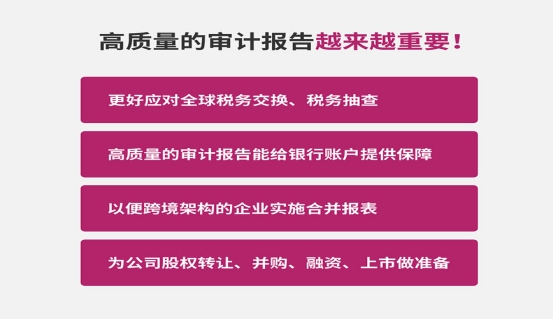
Importance of audit reports